What it is
Stated mission: Youth mental health and suicide prevention
Kiwis For Good Foundation is a registered New Zealand charitable trust (CC57436, Napier), incorporated 14 November 2019 and registered 10 December 2019, with the stated charitable purpose “to support youth mental health and suicide prevention” (Charities Services). A full review of its website — all 89 published pages — shows an organisation that is, in practice, several things at once: a media/publishing operation (~80 “Stories” articles, 2019–2026, on suicide, antidepressants, vaccines, gender surgery, pornography, nutrition, psychedelics and more, plus animations, short films and two documentaries); The Hero’s Journey, a free year-long programme for young men aged 16–25 (gym memberships, fortnightly mentoring, “over $10,000 in prizes”); funding for a BRAVE Foundation programme for young survivors of sexual assault (amount undisclosed); promotion of the chairman’s Somatic Compassion therapy plus a charity-produced documentary about it; Awakiri Hau Tapu, described as a Māori-principles healing programme; Bring Back Storytime, illustrated children’s books sold via the online store; free counselling via BetterHelp (2023–24) for 13–25-year-olds; and continuous fundraising — street collections, Adflex Marketing tele-fundraising, the $20 “Give More, Get More” subscription/prize-draw, merchandise and retail partnerships.
This report is not a claim that the Foundation is a scam, a fraud, or a criminal enterprise — we found no evidence of that, and the register record is clean. It is an argument that criticism, alternatives, and hope all have to be honest — and that an organisation asking for donations and the trust of vulnerable young people has to meet the standard it invokes when it calls itself “evidence-based.”
The commercial & fundraising web
Kiwis For Good Ltd
Company NZBN 9429047797802, incorporated 14 November 2019, sole director Timothy Baker; the register lists the Foundation as its ultimate holding entity — the reverse of the 2019 “profits channelled to the foundation” description. Current financial flows are not publicly documented.
KiwisForGoodShop & the prize draw
The $20 “Give More, Get More” subscription buys a $20 e-voucher (discounted movie tickets etc.) plus one entry per $20 into a $10,000 guaranteed cash prize draw (“Support, Save & Win”). The promotion ran 13 October 2025 – 14 October 2026, with the draw on 19 October 2026 at 301/6-8 Heather Street, Parnell, Auckland. It is explicitly not tax-deductible — legally a product purchase, not a donation. Fundraising is conducted by Adflex Marketing (Australia) via face-to-face and tele-fundraisers; the charity’s own contact page routes campaign enquiries to Adflex. The commission share is undisclosed — face-to-face agency commissions of 50–100% of first-year revenue are common industry practice.
Other commercial activity
Online merchandise (eight T-shirt/hoodie designs), illustrated digital children’s books (“shop with purpose”), a Grounded Kiwi 5%-of-sales partnership, and the 2019–20 “paid distributors” model (homeless/unemployed people paid to distribute literature; outcomes never reported).
The money
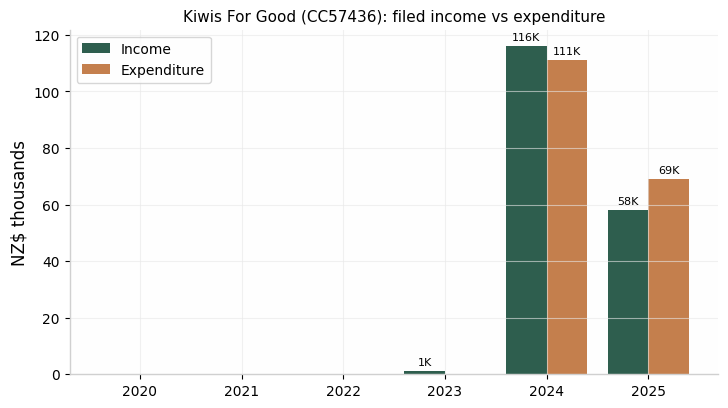
Filed returns (years to 31 March): 2020 NZ$0 income / NZ$0 expenditure (dormant); 2021 NZ$0 / NZ$0 (dormant; clean audit); 2022 NZ$0 / NZ$0 (dormant); 2023 ~NZ$1K / ~NZ$0 (relaunch); 2024 NZ$116K / NZ$111K (street fundraising + BetterHelp pilot); 2025 NZ$58K / NZ$69K — a deficit of ~NZ$11K (CharitiesWatch NZ).
FY2025 key statistics: total assets ~NZ$8K; equity ~NZ$6K; reserves ≈ 1 month (rated “Critical”); revenue diversification 0/100 (Herfindahl 9,980, “highly concentrated”); 99.9% donations; 8 staff; 0 volunteers.
Analysis. (1) Income halved while spending rose — on filed figures the charity is one bad fundraising quarter from insolvency. (2) Advertised commitments (gym memberships, $10K+ prizes, funded counselling, 8 staff, two documentaries, BRAVE funding) outrun filed resources; either much is in-kind/sponsored or the promises exceed means. (3) Tier 3 simple-format filing means no public programme-vs-fundraising breakdown — in particular, what Adflex Marketing retains from collections is invisible.
Red flags vs mitigations
Both sides of the record, as the report presents them. Red flags are context and legitimate questions for the board — not findings of wrongdoing; the mitigations are what fairness requires us to state alongside them.
Red flags
- CCHR/Scientology trustee on the board of a suicide-prevention charity (trustee Mike Ferriss, appointed March 2026).
- Havening-practising chair whose commercial method the charity promotes with charitable funds and films — a conflict of interest.
- A dozen-article anti-antidepressant operation, including Epstein guilt-by-association, an illegal-psychedelic-supplier profile, and a “depression is just life trauma” page aimed at parents.
- Gender-surgery and vaccine-mandate culture-war content.
- FTC-censured offshore counselling partner (BetterHelp, 2023–24).
- One month of reserves; ~100% donation concentration; officer red flag on the register.
- Undisclosed fundraising-agency commissions (Adflex Marketing).
- No published safeguarding, clinical governance, or programme evaluation — despite recruiting at-risk 16–25-year-olds.
- Fabricated “suicide notes” statistic (Claim 1); invented recovery-house statistics (Claims 44–45).
Mitigations
- Clean register status and a clean FY2021 audit; no fraud findings or regulator action.
- CCHR NZ’s Lake Alice advocacy was genuinely valuable and nationally recognised.
- Youngson’s mainstream credentials are real (NZMA Chair’s Award 2016; WHO patient-safety work).
- The August 2026 Horowitz tapering article is substantially responsible content.
- Exercise, mentoring and community have modest real evidence.
- No religious content on programme pages.
- The <i>Miracle in Raglan</i> page carries an honest “not medical advice” disclaimer.
- Lifeline, Youthline and 1737 are listed on the help pages.
This report is not a claim that the Foundation is a scam, a fraud, or a criminal enterprise — we found no evidence of that, and the register record is clean. It is not an attack on religion, on lived experience, on exercise, mentoring, nutrition, or community — several of those have real (if modest) evidence behind them, which this report states. It is not an argument that medication is always right, that psychiatry is beyond criticism, or that the mental-health system is adequate — New Zealand’s system has real, documented failures, and criticising it is legitimate and necessary.