The verdict scorecard
Every claim, referenced and countered
All claims are quoted verbatim from kiwisforgood.co.nz; every page was retrieved and archived on 1–2 October 2026. Verdict labels are the report’s own wording.
A. The Hero’s Journey page
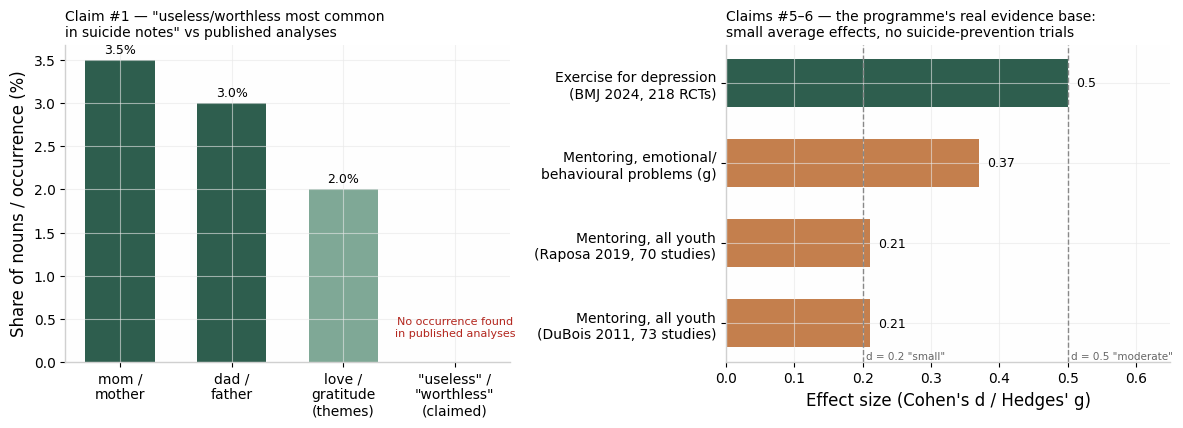
No source is given and none exists. Content analysis of genuine suicide notes dates to Shneidman & Farberow’s 721-note corpus (1957); the consistent finding across decades is that the most frequent content is references to family members and expressions of love and attachment, not self-deprecating adjectives. A 2025 Korea Foundation for Suicide Prevention/KAIST analysis found the most common nouns were “mom/mother” and “dad/father,” with notes dominated by love, gratitude, sadness and consideration; a 2025 AI-aided analysis found “dad,” “mom” and “hope” as the top terms. The legitimate adjacent finding is that completed-suicide notes show more absolutist language and blame than attempters’ notes — cognitive constriction, not “useless/worthless.” Only ~15–38% of people who die by suicide leave any note at all, so the claim cannot ground a general theory regardless.
Why it matters: this is rhetorical invention — it frames the problem as deficient self-worth fixable by “levelling up,” rather than the multi-causal clinical/social phenomenon the evidence describes.
There is no recognised research field called “the science of fulfilment” and no published “four pillars” model. The framing borrows the silhouette of self-determination theory (autonomy, competence, relatedness — Deci & Ryan) and Seligman’s PERMA without their definitions, measures or evidence base, and adds “physical strength,” which appears in neither. “Change becomes unstoppable” is unfalsifiable: no outcome, mechanism, comparison condition or timeframe. Scientific vocabulary used as decoration.
Pattern note — four pillars without the whare. The “four pillars” pitch sits one rebrand away from Mason Durie’s Te Whare Tapa Whā (taha tinana, taha hinengaro, taha whānau, taha wairua), the Māori holistic-health model ubiquitous in New Zealand mental-health settings: three of the four pillars map almost directly, “sense of purpose” is a secularised stand-in for wairua, and the foundation Durie’s model rests on — whenua, land and belonging — is absent altogether. Four-part wellness models are generic internationally (the WHO’s 1948 definition of health predates Durie), so direct derivation cannot be proven, and the site’s own borrowing is more securely traced to self-determination theory and PERMA (see verdict above). What is observable is the surrounding pattern: the charity also promotes Māori-named healing content — “Awakiri Hau Tapu,” described as “rooted in Māori principles, offering holistic healing and spiritual restoration” yet published without a dedicated page, and the te-puna-aio-the-breath-of-hawaiki article presenting Māori spiritual healing as a mental-health intervention without evidence framing (Appendix A) — while no Māori advisors, kaumatua or partnerships are named anywhere on the site. What is stripped out is exactly what makes Te Whare Tapa Whā Māori: collectivist whānau accountability, spiritual practice grounded in te ao Māori, and Durie’s explicit positioning of the model as complementing, not replacing, clinical care. The holistic silhouette is retained; the kaupapa is not — cultural vocabulary used as decoration, in service of anti-medication messaging the source model does not support.
The 2024 BMJ network meta-analysis (218 RCTs, 14,170 participants) found walking/jogging, yoga and strength training significantly reduce depressive symptoms with moderate effect sizes — but the trials are overwhelmingly in adults with diagnosed depression; earlier meta-analyses carry low GRADE confidence; exercise is a complement to, not a replacement for, treatment in moderate-to-severe illness; and there is no RCT evidence that gym access reduces suicidal behaviour. A free membership addresses access, not adherence — the hardest part for a depressed teenager.
DuBois et al. (73 evaluations) and Raposa et al. 2019 (70 studies, 25,286 youth) both find overall effects d ≈ 0.21 — small, ~nine percentile points — concentrated in attitudes/behaviour, with emotional outcomes smaller (d ≈ 0.15). For youth with existing mental-health problems the evidence is weaker still (“minimal support,” one review concluded; g ≈ 0.37 in a 13-study meta-analysis for youth with emotional/behavioural problems). Effects depend on ongoing mentor training, structured activities, monitoring, interest-based matching (d = 0.41 vs 0.20) and long match duration — none documented by KFG. No mentoring trial has demonstrated suicide-prevention effects.
No qualifications, registration bodies, curricula, supervision arrangements or names are published anywhere on the site. In NZ, “psychologist” is a protected title (NZ Psychologists Board); informal “counsellor,” “mentor” and “life coach” are not. Facilitators are explicitly tasked with identifying when a mentee needs “trauma management or counselling” — quasi-clinical triage of at-risk 16–25-year-olds by unspecified people, under a board containing a CCHR director and a Havening practitioner.
Not a scientific claim, but checkable: the charity’s total filed FY2025 revenue was NZ$58K with expenditure of NZ$69K and ~NZ$8K in assets (CharitiesWatch NZ). A prize pool exceeding ~17% of annual revenue — alongside gym memberships, funded counselling and 8 staff — warrants asking whether the figure refers to a single year, multi-year totals, or in-kind/sponsored prizes.
No collaborators are named; no arrangements, supervision or referral pathways are published.
No cohort size, completion numbers, outcome measures or evaluations are published.
B. The antidepressant cluster
Dispensing counts are not patients; a fourfold rise reflects population growth, longer courses, repeat dispensing, reduced stigma and better access. Rising treatment alongside rising suicide rates is a population-level correlation carrying no causal information — by the same logic any expanding health service “corresponds disturbingly” with the problem it treats. If anything, international evidence runs the other way: countries with greater adolescent SSRI use have shown lower youth suicide rates in several analyses, and the FDA’s 2004 warning-era decline in prescribing was followed by a rise in youth suicide. The article quotes a “Dr. Emma Lawson, a mental health expert” — no clinician or researcher of that name with that quote is publicly traceable.
Moncrieff et al. 2022 examined aetiology — whether low serotonin causes depression — and said nothing about whether SSRIs work; drugs routinely work without correcting a simple “imbalance” (paracetamol does not cure a paracetamol deficiency). A 35-author rebuttal (Jauhar et al., Molecular Psychiatry 2023, “A leaky umbrella has little value”) identified methodological flaws, arbitrary quality cut-offs and omitted evidence (e.g., tryptophan-depletion relapse in remitted patients). Antidepressant efficacy rests on independent ground: Cipriani et al. 2018 (Lancet, 522 double-blind RCTs, 116,477 participants) found all 21 antidepressants more effective than placebo. KFG converts “the simplest serotonin slogan is wrong” into “the scientific underpinnings of SSRIs face scrutiny” — a non sequitur functioning as anti-medication messaging to vulnerable readers.
Moncrieff et al. 2022 examined aetiology — whether low serotonin causes depression — and said nothing about whether SSRIs work; drugs routinely work without correcting a simple “imbalance” (paracetamol does not cure a paracetamol deficiency). A 35-author rebuttal (Jauhar et al., Molecular Psychiatry 2023, “A leaky umbrella has little value”) identified methodological flaws, arbitrary quality cut-offs and omitted evidence (e.g., tryptophan-depletion relapse in remitted patients). Antidepressant efficacy rests on independent ground: Cipriani et al. 2018 (Lancet, 522 double-blind RCTs, 116,477 participants) found all 21 antidepressants more effective than placebo. KFG converts “the simplest serotonin slogan is wrong” into “the scientific underpinnings of SSRIs face scrutiny” — a non sequitur functioning as anti-medication messaging to vulnerable readers.
Study 329 is genuinely a landmark case of trial-data distortion: the 2001 Keller et al. publication claimed an efficacy the data did not show, and the independent RIAT reanalysis (Le Noury et al., BMJ 2015 — Healy as senior co-author, not leader) found no efficacy and elevated harm; GSK’s US$3bn US Department of Justice settlement (2012) included charges over unlawful promotion of paroxetine for under-18s. But the “lessons ignored” framing inverts the actual outcome: precisely because of Study 329, paroxetine is not recommended for under-18s in NZ (Medsafe data sheet) and international guidelines, and carries the paediatric warning the article itself cites. A residual ~1,330 under-19 dispensings — out-of-guideline remnants, off-label indications or continuations from childhood — across a population of ~1.2 million under-19s is not “widespread prescription”; and the headline “10,000 prescriptions under 30” quietly redefines “youth” to include adults in their twenties, for whom paroxetine is a legitimate option. The article ends by pivoting to the charity’s own “holistic, non-pharmaceutical” programme as the alternative — the destination the history lesson was always driving at.
Epstein’s 2011 email musings about love and SSRIs have zero pharmacological content; a medication’s safety and efficacy are properties of clinical trial evidence, not of who once mused about it in an email. This is poisoning-of-the-well rhetoric aimed at parents of depressed children, deployed by a registered suicide-prevention charity — and it ends by funnelling readers to the charity’s own “alternatives,” including its chairman’s commercial, untested therapy.
Emotional blunting is a real, documented side effect in a minority of patients (estimates vary widely, ~20–50% in some surveys) and is a legitimate thing to discuss with a prescriber. Fisher’s “romantic love = low-serotonin state” is speculative evolutionary anthropology, not clinical evidence about SSRIs. The article converts a manageable side effect into a reason to reject the drug class wholesale.
Off-label prescribing under specialist care is legal, guideline-governed (fluoxetine is first-line pharmacotherapy for moderate-severe youth depression in international guidelines, with monitoring), and disclosed — not a hidden abuse.
Contradicts the entire clinical evidence base: twin-study heritability ~40%, established neurobiology, chronic and severe courses, treatment-response data. No body of “latest science” supports this; it is the inverse of the evidence. Aimed at parents (“desperate parents resort to medicating children”), it risks delaying assessment of exactly the children most at risk.
The count is plausible as raw dispensing data, but counts are not patients; infant/under-4 antidepressant prescriptions are typically data artefacts or non-psychiatric indications (e.g., off-label sleep, pain, enuresis), not toddlers being medicated for sadness — which is what the article invites readers to conclude.
Williams’s Rethinking Madness sits in the Mad-in-America critical-psychiatry ecosystem (endorsed by Robert Whitaker). Antipsychotics have robust RCT evidence for acute psychosis and relapse prevention; the “long-term worsening” hypothesis is contested, not established; duration of untreated psychosis is one of the best-documented predictors of poor outcome. A first-episode patient persuaded by this content to reject treatment faces measurable harm. Open Dialogue/Soteria-style approaches are legitimate research areas with small, mixed evidence — not proven replacements.
Williams’s Rethinking Madness sits in the Mad-in-America critical-psychiatry ecosystem (endorsed by Robert Whitaker). Antipsychotics have robust RCT evidence for acute psychosis and relapse prevention; the “long-term worsening” hypothesis is contested, not established; duration of untreated psychosis is one of the best-documented predictors of poor outcome. A first-episode patient persuaded by this content to reject treatment faces measurable harm. Open Dialogue/Soteria-style approaches are legitimate research areas with small, mixed evidence — not proven replacements.
The inquest reporting is fair — but a single inquest is an anecdote about a known, warned-about risk (early-treatment suicidality warnings exist precisely because of such cases), spun into “the urgent need to rethink the widespread use of antidepressants” generally. One coronial case cannot estimate incidence, and the article omits that untreated depression is itself the largest suicide risk factor.
Youth suicide trends track social factors, and NZ rates have in fact fallen relative to long-run averages in recent years; treatment access remains low relative to prevalence, so “we treated and it didn’t help” is unsupported. The book is self-published advocacy (endowed by a Rucklidge endorsement), not peer-reviewed evidence.
The article’s core practical content is the site’s most responsible: Horowitz/Taylor hyperbolic tapering, The Maudsley Deprescribing Guidelines, “never stop suddenly,” “work with a doctor” — all mainstream-valid. But the framing sentence converts legitimate deprescribing guidance into a blanket judgement on long-term treatment. Relapse-prevention trials show continued treatment benefits many patients; guidelines support review and tapering when appropriate, not a presumption against duration.
Withdrawal-vs-relapse confusion is documented (Horowitz & Taylor 2019); this is one of the site’s more defensible claims — though Barnett is a prominent anti-mandate commentator writing from the same political cluster as the mandate article, and her own account describes ceasing medication abruptly, which is precisely the pattern guidelines warn against and slow tapering is designed to prevent. Her suffering was real; its cause was the manner of stopping, not the existence of the medication.
C. Culture-war and fringe-cause articles
The underlying study (Cureus 2024, TriNetX records) is real, but: (i) its senior author, Dietrich Jehle, publicly stressed it examined “associations with outcomes rather than causation” and did not isolate the effect of surgery; (ii) the control groups were non-trans populations — including pharyngitis patients — not the only valid comparator (trans people seeking but denied surgery); (iii) trans adults have substantially elevated baseline suicidality before any surgery, so an elevated post-surgery rate says nothing about the effect of surgery; (iv) the study’s actual conclusion was a call for post-procedure psychiatric support — the opposite of the article’s implication. Studies with better comparators (e.g., Almazan & Keuroghlian 2021, JAMA Surgery) associate gender-affirming surgery with lower odds of recent suicidal ideation, and regret rates in modern series are under ~1–2%. Note the design detail the article omits: Group A were people who had surgery and later visited an emergency department — an inherently selected, unwell sample.
The kernel is real — mandates imposed genuine distress on some trauma survivors, and exemption handling was rigid; the Royal Commission itself recommended more compassionate exemption processes. But the moral frame inverts the evidence: peer-reviewed modelling (Datta et al., Vaccine 2024) estimates COVID vaccination saved ~6,650 NZ lives and prevented ~45,100 hospitalisations in 18 months, a finding the NZ Royal Commission endorsed in crediting the elimination-plus-vaccination strategy with one of the world’s lowest pandemic mortality rates. The article presents three anonymised anecdotes as proof of systemic “abuse” and “gaslighting,” while its author — then a registered medical practitioner — advertises that he can “erase” the resulting trauma with his own unevidenced therapy.
The kernel is real — mandates imposed genuine distress on some trauma survivors, and exemption handling was rigid; the Royal Commission itself recommended more compassionate exemption processes. But the moral frame inverts the evidence: peer-reviewed modelling (Datta et al., Vaccine 2024) estimates COVID vaccination saved ~6,650 NZ lives and prevented ~45,100 hospitalisations in 18 months, a finding the NZ Royal Commission endorsed in crediting the elimination-plus-vaccination strategy with one of the world’s lowest pandemic mortality rates. The article presents three anonymised anecdotes as proof of systemic “abuse” and “gaslighting,” while its author — then a registered medical practitioner — advertises that he can “erase” the resulting trauma with his own unevidenced therapy.
Cited authorities include the Institute for Family Studies — a US conservative advocacy think tank, not a neutral research body. The research literature is genuinely mixed and mostly correlational; there is no professional consensus on “porn addiction” as a diagnosis (it is not in DSM-5), and societal-level claims about collapsing birth rates are speculation. Real concerns about adolescent exposure exist — but the article’s certainty and sourcing are advocacy, not science.
Meta-analyses find an association (OR ≈ 2.5 for suicide attempts in seropositive people) from correlational case-control serology with heavy confounding — infection risk correlates with the same deprivation and exposures that correlate with mental illness. No study establishes causation; no psychiatric body treats parasite screening or treatment as a mental-health priority.
Population studies find small associations between antibiotic courses and later depression diagnoses, with substantial residual confounding (the underlying illness itself, and the healthcare contact that produces both). Gut-brain-axis research is early-stage; “can lead to depression” overstates it.
Psilocybin trials are genuinely promising but early-phase, in screened participants with pharmaceutical-grade dosing and professional support; no trial supports use in dementia. A sympathetic, anonymous profile of a prosecutable supplier serving vulnerable people — explicitly including people wanting to quit antidepressants — is normalisation of dangerous illegal self-medication by a registered charity.
D. Alternative-treatment promotion
Somatic Compassion is chairman Youngson’s own branded method. Its parent technique, Havening, rests on its inventor’s hypothesis that touch generates delta waves that “depotentiate” trauma-encoded synapses. The evidence: a 2018 post-surgical study found Havening did not reduce pain-medication use, complications or readmissions; a 2022 n=24 single-session study without adequate control found reduced self-reported distress; other small studies are promoter-run. Mainstream medical references state there is no scientific proof of effectiveness and warn it must not replace evidence-based care; even Havening’s own European clinics concede it “is not a medical treatment.” The polyvagal scaffolding is itself contested — Grossman 2023 (Biological Psychology) detailed likely refutations of its five premises; a 2026 multi-author critique called the theory “untenable” (Porges disputes this; fair summary: contested framework marketed as settled science). The charity-produced film is advertised for community screenings with a donation ask — charitable resources promoting the chairman’s commercial practice.
Somatic Compassion is chairman Youngson’s own branded method. Its parent technique, Havening, rests on its inventor’s hypothesis that touch generates delta waves that “depotentiate” trauma-encoded synapses. The evidence: a 2018 post-surgical study found Havening did not reduce pain-medication use, complications or readmissions; a 2022 n=24 single-session study without adequate control found reduced self-reported distress; other small studies are promoter-run. Mainstream medical references state there is no scientific proof of effectiveness and warn it must not replace evidence-based care; even Havening’s own European clinics concede it “is not a medical treatment.” The polyvagal scaffolding is itself contested — Grossman 2023 (Biological Psychology) detailed likely refutations of its five premises; a 2026 multi-author critique called the theory “untenable” (Porges disputes this; fair summary: contested framework marketed as settled science). The charity-produced film is advertised for community screenings with a donation ask — charitable resources promoting the chairman’s commercial practice.
Rucklidge’s RCTs are real and peer-reviewed, with modest effects and mixed replication; she herself cautions that micronutrients are not cures. The article’s “revolution” framing exceeds the evidence — and note the pattern: legitimate-but-preliminary alternative research is consistently presented as stronger than mainstream pharmacotherapy.
Based on correlational and small-trial evidence; “proven” is not defensible. Harmless in itself, but part of the same editorial pattern.
Davidson’s meditation neuroplasticity work is real; “rewire your brain for happiness” is self-help simplification.
Foulkes & Andrews’ “prevalence inflation” is a genuine, untested hypothesis from legitimate researchers; the article presents it as nearer-established than it is.
E. Statistics and policy articles
617 matches the Chief Coroner’s provisional 2023/24 count (rate 11.2 per 100,000); NZ’s teen rate has genuinely been at/near the OECD top. But the site omits that the 2023/24 rate was ~3.6% below the 15-year average, 2024/25 (630 deaths) was 3.1% below the 16-year average, and Ministry trend data show a ~20% decline 1996–2016; the “29% increase” reflects raw counts against population growth, not rates. Māori rates remain roughly double non-Māori — the crisis is real; the alarm is selected for.
617 matches the Chief Coroner’s provisional 2023/24 count (rate 11.2 per 100,000); NZ’s teen rate has genuinely been at/near the OECD top. But the site omits that the 2023/24 rate was ~3.6% below the 15-year average, 2024/25 (630 deaths) was 3.1% below the 16-year average, and Ministry trend data show a ~20% decline 1996–2016; the “29% increase” reflects raw counts against population growth, not rates. Māori rates remain roughly double non-Māori — the crisis is real; the alarm is selected for.
617 matches the Chief Coroner’s provisional 2023/24 count (rate 11.2 per 100,000); NZ’s teen rate has genuinely been at/near the OECD top. But the site omits that the 2023/24 rate was ~3.6% below the 15-year average, 2024/25 (630 deaths) was 3.1% below the 16-year average, and Ministry trend data show a ~20% decline 1996–2016; the “29% increase” reflects raw counts against population growth, not rates. Māori rates remain roughly double non-Māori — the crisis is real; the alarm is selected for.
Refers to real 2015/16 OECD-data comparisons built on incompatible cross-country definitions; presented as settled current fact.
The post-discharge window is genuinely the highest-risk period — that part is well documented in NZ and internationally. But the specific numbers are not locatable in any published source: no Danish national registry study shows 60–70% post-discharge suicide reductions; no 2021 Soteria meta-analysis reports 50–80% suicide reductions (Soteria research concerns psychosis outcomes); and “zero vs an expected 4–6” is an unsourced counterfactual. Peer respites and step-down care are serious policy options that deserve honest numbers, not manufactured ones.
The post-discharge window is genuinely the highest-risk period — that part is well documented in NZ and internationally. But the specific numbers are not locatable in any published source: no Danish national registry study shows 60–70% post-discharge suicide reductions; no 2021 Soteria meta-analysis reports 50–80% suicide reductions (Soteria research concerns psychosis outcomes); and “zero vs an expected 4–6” is an unsourced counterfactual. Peer respites and step-down care are serious policy options that deserve honest numbers, not manufactured ones.
The figure appears in no official statistic and is unsourced.
No published cases, named lawyers or court outcomes support the claim; it functions as content marketing. Paired with Claim 51 (a testimonial), the debt-relief service has no documented existence beyond testimonials.
AA was founded in 1935 — the claim is arithmetically impossible — and peer-support evidence for addiction is misappropriated to justify the charity’s storytelling model.
The copy — archived via the Green Goddess republication — is copied nearly word-for-word from BetterHelp’s own FAQ. The actual credential floor is a US state licence plus a master’s degree — the modal BetterHelp therapist is a master’s-level counsellor or social worker, not a doctoral psychologist, so “accredited psychologists (PhD/PsyD)” systematically overstates it. More seriously for a NZ youth charity: BetterHelp therapists are licensed in US states, not registered with NZ health-practitioner bodies, so a distressed Kiwi teenager had no NZ complaint pathway, no NZ privacy-law relationship and no clinical accountability under the HPCA Act. And the partner itself had entered a US$7.8m FTC settlement and 20-year consent order in March 2023 — the same period as this copy — for sharing users’ intake-questionnaire answers (including mental-health status), emails and IP addresses with Facebook, Snapchat, Pinterest and Criteo for advertising during 2017–2020. The partnership has since lapsed; the claim stands as an example of the charity amplifying a commercial vendor’s assurances without independent verification.
NZ Health Survey ballpark — this statistic itself is fine; it is the page’s use of it to frame a zero-trial therapy that is the problem (see Claims 11/12, 47).
The BRAVE funding has no disclosed amount, terms or evaluation; the storytime books’ “nurture mental resilience” framing is marketing over the genuine (but generic) evidence that shared reading supports child development.
The BRAVE funding has no disclosed amount, terms or evaluation; the storytime books’ “nurture mental resilience” framing is marketing over the genuine (but generic) evidence that shared reading supports child development.
“Evidence-based solutions” applied to a method with zero trials, in a film the charity produced to promote its chairman’s practice.
F. Claims slipped into narrative and editorial content
No case details, no court or tribunal reference, no named lawyer. A web-wide search found no external coverage of this story anywhere; it exists only on KFG’s own site.
CBT does have the largest trial base of any psychotherapy; the series is the site’s most conventionally accurate mental-health content — notable mainly because it was written by a lay author and because the organisation later pivoted to attacking clinical approaches.
The Ardern government’s 2019 Budget was widely reported as the world’s first wellbeing budget. Included for completeness — and as evidence of the organisation’s originally mainstream, pro-government editorial line.
Not false as opinion, but it seeds the distrust-of-institutions theme that later articles (mandates, medication) build on.
Personal narrative; not itself false, but part of the pattern culminating in the sympathetic 2023 profile of an illegal psilocybin supplier (Claim 39).
The 668 figure is real (provisional 2017/18 coronial count) — and this is the likely source of the “staggering 29%” claim recycled in fundraising copy (Claim 2–4), where raw counts are substituted for rates. Ironically the same article is pro-drug-development — the opposite of the post-2022 editorial line, and evidence that the organisation’s ideology changed with its personnel.
The psychiatrist and counsellors are unnamed; no credentialing is published. This claim lends false clinical authority to the animation’s companion article asserting that depression is “simply a natural reaction to day-to-day traumas” (Claim 25) — the site’s most dangerous combination for parents of distressed children.
These are specific clinical outcome claims with zero controlled-trial support, published by a registered charity about its own trustee’s commercial practice. The NZMJ item referenced is a viewpoint/opinion article, not a trial. Single-session phobia cures and pain resolution via touch are the classic signature of expectancy and placebo effects in uncontrolled settings. The lone hedge (“more formal research is still underway”) inverts the burden of proof.
The evidence base