The verdict scorecard
Key findings
- 01
A Scientology link at board level: trustee Mike Ferriss (appointed March 2026) is the long-time public face and Certification Officer of the Church of Scientology of New Zealand and a director of CCHR NZ — a Scientology-founded organisation whose doctrine holds psychiatry to be a “pseudoscience” and which campaigns against psychiatric medication for minors.
- 02
The chair sells unproven therapy: Dr Robin Youngson (chair since April 2025) is a genuinely decorated retired anaesthetist turned full-time Havening/“Somatic Compassion” practitioner; the charity endorses his method and produced a documentary promoting it — and he authored the charity’s November 2022 anti-vaccine-mandate article nearly three years before joining the board.
- 03
A systematic anti-antidepressant media operation: at least a dozen articles attack SSRI prescribing — the misused Moncrieff serotonin review, a Study 329 exposé, the Thomas Kingston inquest, an article tying SSRIs to Jeffrey Epstein’s emails, a sympathetic profile of an illegal psilocybin supplier — while promoting the charity’s own programmes as the alternative.
- 04
Culture-war content the earlier analysis missed: articles attacking gender-affirmation surgery, the COVID vaccine mandates and pornography (partly sourced from a US conservative think tank) mean the original “no right-wing content” assessment must be revised.
- 05
A fabricated statistic sits at the core of the pitch: “useless” and “worthless” as “two of the most common words found in suicide notes” has no source and contradicts every published analysis of genuine suicide-note corpora (Claim 1, False).
- 06
Extremely thin finances: FY2025 revenue of NZ$58K against NZ$69K expenditure, ~NZ$8K in assets, roughly one month of reserves and ~100% donation dependence — while advertising free gym memberships, “over $10,000 in prizes,” 8 staff, funded counselling and film production (Claims 9/13, Unverifiable).
- 07
A commercial fundraising arm: the KiwisForGoodShop “$20 subscription + $10,000 guaranteed cash prize draw” is operated by Australian telemarketing firm Adflex Marketing, is explicitly not tax-deductible, and its commission share is undisclosed.
- 08
Not a scam — and not what it presents as: the register record is clean, and there is no fraud finding or regulator action. The problem is the gap between the charity’s “evidence-based” framing and what its media output actually promotes (Part 10.3).
The worst offenders
The claims we found to be flatly false or fabricated — each quoted verbatim, with the counter-evidence on the claims page. The full catalogue covers all 58 claims.
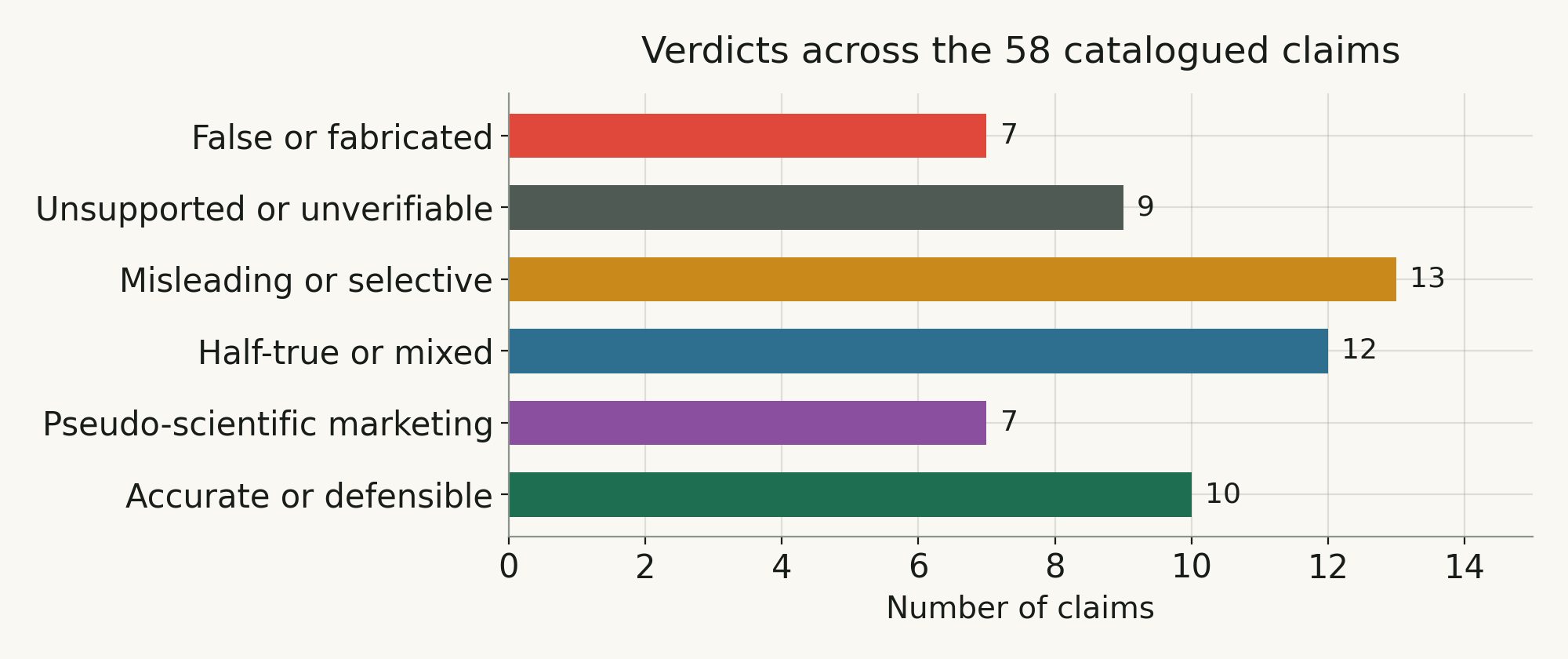
Browse the catalogue by verdict: 7 false · 13 misleading · 9 unsupported · 10 accurate
The ideology: revised assessment
An earlier conclusion (“no right-wing content”) was wrong and is corrected here. The full catalogue shows the site’s ideology is a hybrid:
- Scientology-adjacent anti-psychiatry — CCHR doctrine at board level; “psychiatry is pseudoscience” echoed editorially; medication framed as the scandal.
- Commercially-motivated fringe therapy — the chairman’s Havening/Somatic Compassion practice promoted with charitable funds and films.
- Anti-mandate/anti-state health content — Youngson’s 2022 mandate article; Barnett’s contribution; “gaslighting” framing of government.
- Socially-conservative culture-war content — gender-affirmation surgery, pornography and the “nuclear family”/birth-rate framing, sourced partly from a US conservative think tank.
- Conspiracy-adjacent framing — the Epstein article’s guilt-by-association; debt-collector “extortion” content; unsourced firefighter statistics.
There is still no evidence of Christian-evangelical organising, anti-abortion campaigning or party-political affiliation. But the combination maps recognisably onto the international “medical freedom”/anti-psychiatry/culture-war media ecosystem — with a suicide-prevention charity as the vehicle and vulnerable young people as the audience. What we did not find: fraud, deregistration, regulator action, or any evidence that participants are currently being recruited toward Scientology or told to stop medication. Absence of evidence is stated as such.
Open questions for the board
1. Are Hero’s Journey facilitators supervised by any registered NZ health practitioner, and what is the protocol when a mentee discloses suicidal intent? 2. Are participants ever given advice about psychiatric medication — by whom, and what? 3. Any formal, financial or in-kind relationships with CCHR, the Church of Scientology, Adflex Marketing, or Dr Youngson’s practice beyond what is published? What percentage of $20 subscriptions and street/tele-fundraising reaches the charity? How much was paid for the two documentaries? 4. What does the officer red flag on the Charities Register refer to? 5. Why did the entire 2019–2023 board depart? What vetting preceded the Ferriss and Youngson appointments? 6. Will the charity publish its safeguarding policy, facilitator qualifications, programme outcome data, and the terms/status of the BetterHelp arrangement? 7. Does the board stand behind the Epstein article’s implied argument that parents should reject SSRIs for their children — and the claim that depression is “simply a natural reaction to day-to-day traumas”?
A transparent charity should be able to answer all seven in writing. Concerns about charitable status can be lodged with Charities Services (Department of Internal Affairs); misleading advertising claims can be taken to the ASA.
If you need help, or are choosing where to give
Safer, established options — for support: free call or text 1737 (Need to Talk?, 24/7), Lifeline 0800 543 354, Youthline 0800 376 633, or GP referral to publicly funded care. If a treatment is causing you problems — side effects, feeling worse, wanting to stop — the right move is to tell your prescriber and adjust or taper slowly with support, not to stop suddenly or swap proven care for unproven promises. For giving: established providers publish audited accounts, clinical governance and safeguarding policies — ask for them. Any charity working with suicidal young people should welcome those questions.